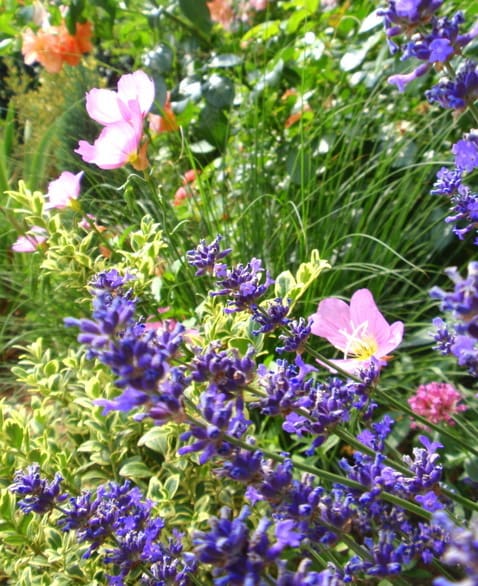
The lovely French lavender is iconic, and though associated with Provence, where it’s commercially grown, it grows beautifully in Burgundy. This time of year the world is singing its praises for its beauty, scent and flavor. A petite confession: I’m an exception, the aroma doesn’t do much for me. But as a plant for the garden, je l’adore. It’s easy to grow, blooms all summer, and it’s perfect in a perennial border, especially by the roses. You can choose tall, short, pale lavender or deep purple. I’m loyal to the handsome and hearty ‘Hidcote’, whose rich purple blooms, shapely form, and long bloom period have endeared it to me.
If you have a number of plants as I do, you’ll end up with quite a harvest of dried lavender. What to do with it? Of course, I use it in cooking. And for hostess gifts, I like to make my own sachets for le boudoir, but of a very particular, and uniquely French, sort.
 I have a rather obsessive passion for vintage French linens. If you sort through a stack at a French flea market, among those linens you are likely to see something that may puzzle you. Small rectangular pockets that fold over, each one embroidered with a different motif. They may have an initial, a design, or a fanciful bird or flower done in bright colors. Whatever are they for?
These are called portes serviettes, and back in the day, les femmes françaises embroidered a set of them, each one unique, to hold the family’s napkins. After each meal, you put your napkin back in your personalized pocket, so the napkins could be reused, and they never got mixed up. Very clever, those French.
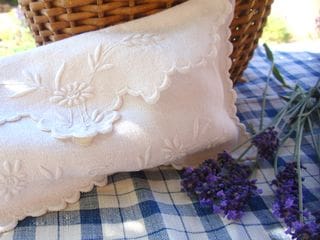 So I collect these little works of art, which normally sell for a couple of Euros each, and I insert a pillow of lavender into each one. Et voila, a gift that is oh so French. One could also make them out of any little bits of pretty fabric and ribbon (Yikes, this all sounds very “Martha”, doesn’t it? I’m not usually so crafty, you’ve just read my full repetoire).
Of course we must have a recipe with lavender too, and I’ve come up with one that’s a bit unusual. My step-daughter Kelly told me that her grandmother makes her own herbes de Provence, and lavender is her secret ingredient. That sounded intriguing (ever made your own herbs de Provence? Me neither). So I’ve researched it, to share with y’all.
RECIPE: Homemade Herbes de Provence
 There are 3 ways to make herbes de Provence: dry your own herbs (grow them, or use bunches from the market); use purchased dried herbs to make your own mix; or use fresh herbs, chopped and thrown right into the bowl or pot.
To dry your own: hang herbs in upside-down bunches in a place out of direct sun and heat. When dry, snip and throw them in a food processor, or use a mortar and pestle or the back of a spoon to crush them. Then follow directions below.
For purchased dried herbs, just mix them in a bowl and store, covered tightly.
For a fresh herb mix: since fresh herbs are not as potent, use them by the handful, chopped. No need to measure, but use your nose: certain herbs, like rosemary and lavender, have a stronger flavor, so use them more sparingly. Fresh herbs are most often sprinkled on a dish after or toward the end of cooking (with some exceptions, like rosemary and bay leaf).
Now, for your choice of herbs: You really can’t go wrong here. Rosemary, thyme and bay are traditional in herbes de Provence. But other herbs that grow in Provence are usually added, and I found recipes with everything from mint to orange peel. So go wild, using your nose and taste buds to guide you.
Below is a list of possible dry herbs to use, and some suggested relative proportions. Start with the big 3, plus a little dried lavender of course, then add more to your taste.
Start with a tablespoon of: rosemary, crushed bay leaf, thyme, and a teaspoon of lavender.
Then add as desired, up to a Tablespoon of: basil, oregano, chervil, summer savory.
If desired add a teaspoon of: mint, lemon peel, orange peel, marjoram, sage, fennel seeds, tarragon.
Now how to use them? Oh my goodness, most everywhere. Sprinkle them over a roasting chicken. Toss them with cooked green fresh beans, sautéed quickly in olive oil. Stir some into your vinaigrette. Mix them with oil and lemon juice, for a marinade, or do a dry rub. Tie up a little bag of them for a gift. I’m sure y’all can come up with a lot more ideas!
There is a Lavendar festival every year in Tuscania, Italy. Cruise over to the Italian Notebook site (http://www.italiannotebook.com/events/lavender-festival), and read the July 2nd post that will give you all the details.









6 thoughts on “Futzing About with French Lavender”
Have you tried a couple of heads of lavender with a sprig of mint as a tisane? It makes a wonderful summer drink.
Friends in Tuscany (there’s a lot of lavender there, as well as here in Umbria) have a lavender cookbook. Which I think they don’t use; they just toss in a little here and there in the Italian way. And their house smells heavenly.
Martha Stewart? No, not at all. More like mindful genteel living. The lavender in my backyard smells a little like catmint to me, that is, not to my taste, and your dissent about the charms of French lavender’s aroma sent me to the encylopedia and sure enough both are in the mint family.
bonjour Lynn,
We seem to be in sync! I have posted about lavender this week myself. If you or your readers would like a splash of the fascinating history behind the herb, take a look at http://www.myfrenchrevelation.blogspot.com
I have a small patch of this luscious purple plant growing in my garden, to remind me of France. It is permanently in flower here in Queensland Australia, I suspect because I negelect it. (No green thumbs on these hands!) I’m also a soft spot for the delicate embroidered linen pieces you find in the markets. Thank you for your stories, Gai Reid
My experience with lavender, which I LOVE, is that it tastes terrible! So…I make my herbs de Provence, as you suggest (I use more tarragon and orange peel because I like it, but one really cannot mess this up…be intrepid), and I put it in those little muslin bags that you can buy for loose tea.
Alternatively, and a LOT cheaper, is to buy cheesecloth and cut it into (double thickness) squares, tying it with white thread or kitchen twine.
I use them as you’ve described, and then…voila…no little flakes of lavender in the otherwise delicious food. Especially the roast chicken. YUM.
A dozen of these, packed beautifully, make a fabulous and appreciated Christmas gift…include a couple of ways to use them (and you CAN drop them into the tub!), and you’re good to go!
I LOVE your site, and like so many who comment, I am envious! Thank you for sharing your great good fortune with us.
Linda5051
Thanks for a lovely summary of the amazing aromatic herb we know as lavender. I love all things lavender and have started blogging about it; so really enjoy reading other peoples articles.
I love the English lavender although here in Oz French lavender is also easy to grow.
Love the crafty things you displayed too….aren’t the French artful?!
Patricia Perth Australia
http://www.lavenderuses.com
all things lavender